

First data on elevated natural hydrogen occurrence at a site in SE Sofia, Bulgaria
Dimitar Antonov1, Tsvetelina Toleva2, Blagoy Burdin3, Svetoslav V. Georgiev1, Jürgen Grötsch4
1 Geological Institute, Bulgarian Academy of Sciences, Acad. G. Bonchev Str., bl. 24, Sofia 1113, Bulgaria; E-mails: dimia@geology.bas.bg; s_georgiev@geology.bas.bg
2 TITAN Group, Cherni Vrah, blvd., 33E, Sofia 1421, Bulgaria; E-mail: tsvetelina.toleva@abv.bg
3 Institute of electrochemistry and energy system, Bulgarian Academy of Sciences, Acad. Georgi Bonchev Str., bl. 10, Sofia 1113, Bulgaria; E-mail: b.burdin@iees.bas.bg
4 Geocentre Northern Bavaria, Friedrich-Alexander-Universität Erlangen Nürnberg, Schlossgarten 5, 91054 Erlangen, Germany; E-mail: juergen.groetsch@fau.de
Dimitar Antonov, Tsvetelina Toleva, Blagoy Burdin, Svetoslav V. Georgiev, Jürgen Grötsch. 2025. First data on elevated natural hydrogen occurrence at a site in SE Sofia, Bulgaria. – Rev. Bulg. Geol. Soc., 86, x, x–x, https://doi.org/10.52215/rev.bgs.2025.86.x.x.
Abstract. This study investigates the presence of naturally occurring hydrogen (H₂) within the Sofia Region, focusing on its possible relation to fault-controlled gas migration. Measurements were conducted at the Botanical Garden of the Bulgarian Academy of Sciences, situated along the Vitosha fault – part of the Iskar fault zone. Hydrogen concentrations were determined using a Dräger X-am® 8000 detector at a depth of 0.8 m, following procedures previously applied for radon and soil gas permeability. Five sampling points were examined, including sites located directly on and away from the fault zone. Elevated hydrogen concentrations of up to 200 ppm were recorded along the fault, whereas peripheral points showed values between 15 and 25 ppm. These results indicate a clear hydrogen anomaly spatially correlated with the fault trace, suggesting ongoing gas migration through a hydraulically active structural zone. Our findings represent the first field evidence of natural hydrogen occurrence in the Sofia Region.
Keywords: molecular hydrogen, geology, faults, radon gas
Introduction
Natural hydrogen, denoted also as “white hydrogen”, refers to molecular hydrogen (H₂) generated by endogenous geological processes within the Earth’s crust (e.g. Prinzhofer, Deville, 2015; Zgonnik, 2020; Jordanov, 2024, Wicks, 2024). It represents a naturally formed gas that can migrate and accumulate underground ‒ similar to how natural gas forms and is either trapped in reservoirs as free gas accumulation or as dissolved gas in aquifers (Williams, Hemley, 2001). While prospecting and exploring, occurrences of natural hydrogen have been reported in a variety of geological environments, including ophiolite complexes, sedimentary basins, mid-oceanic ridges and crystalline basement terrains (Prinzhofer et al., 2019; Sherwood Lollar et al., 2024; Gelman et al., 2025). Documented cases such as the Bourakebougou water well in Mali confirm the presence of significant accumulations of naturally generated hydrogen in settings with favourable structural and sealing conditions (Prinzhofer et al., 2018; Maiga et al., 2023).
The main mechanisms responsible for natural hydrogen formation include (e.g. Milesi et al., 2015; Jackson et al., 2024; Kozhoukharova, Jordanov, 2024; Sherwood Lollar et al., 2024):
(i) water–rock interactions, particularly serpentinization and oxidation of iron-bearing minerals in ultramafic and mafic rocks, where hydrogen is released as a by-product;
(ii) radiolysis of water, caused by the decay of uranium, thorium, and potassium isotopes that split water molecules and generate hydrogen over long geological periods;
(iii) degassing of deep crustal or mantle fluids, through which hydrogen is transported upward along faults or fractures from deeper sources; and
(iv) organic decomposition — in sedimentary basins, the breakdown of organic matter can release small amounts of hydrogen at high temperatures.
In addition, several studies discuss the key migration mechanisms of the hydrogen transport including diffusion and advection, and how these mechanisms are influenced by factors like geological structure and fault zones (Lefeuvre et al., 2022; Langhi, Strand, 2023; Lodhia et al., 2024; Cao, Ning, 2025).
Finally, the co-occurrence of light gaseous hydrocarbons with radon has been documented in studies of radon concentrations in natural gas systems (Andreae et al., 1991; Yver et al., 2009; Alali et al., 2019). These associations suggest that radon activity can serve as an indirect geochemical tracer of hydrogen transmissivity and fluid migration potential along both active and inactive fault zones.
Understanding these processes and their geological controls provides a foundation for assessing the potential for natural hydrogen accumulation, as explored in the present study focused on a site within the Sofia Region. The aim of this research is to explore whether areas with recorded elevated radon concentrations in soil gas are characterized by concomitant elevated emissions of hydrogen gas.
Materials and methods
Study area. The sample site is located on the territory of the Botanical Garden at the National Academy of Sciences. The geological structure is characterised by the volcanogenic-sedimentary association in depth (Yaneva et al., 2002; Yaneva, Donkova, 2017), overlain by a general deluvial‒proluvial fan, the latter being subject to landslide processes (Tsenkov, Ivanov, 2004). This location was selected due to the presence of the NW-SE Vitosha fault (Fig. 1), part of the Iskar fault zone (Zagorchev et al., 1994; Radulov et al., 2023; Pashova et al., 2024). Five hydrogen gas samples were taken at locations immediately above and at variable distances away from the fault zone (Fig. 1). This sampling strategy closely follows the approach by Antonov et al. (2022), who showed almost three times elevated radon soil gas concentration of 52.3 kBq/m3 (average value) in the immediate proximity of the fault zone compared to background radon concentration of 18.9 kBq/m3 (average value) away from the fault zone.
Sampling and equipment. The hydrogen gas sampling procedure, originally inspired by the approach developed by Dr. Grötsch and subsequently applied for hydrogen detection, followed the same protocol used for radon soil gas measurements (Antonov et al., 2022). A hollow sampling rod was inserted to a depth of 0.80 m below the surface to eliminate atmospheric contamination of soil gas (Neznal et al., 2004). The rod was connected via a flexible hose to an in-situ hydrogen sensor measuring hydrogen concentration (one measurement at a single field point). Measurements were conducted using a Dräger X-am® 8000 device equipped with a DrägerSensor® XXS H₂ (0–2 000 ppm range).
Results and discussion
Hydrogen concentrations measured along the fault reached approximately 50 ppm at field point 1 (FP_1) and slightly above 200 ppm at field point 2 (FP_2). In contrast, the lateral points (FP_3 – FP_5) exhibited lower concentrations, ranging between 15 and 25 ppm. The local atmospheric background in the vicinity of the fault was approximately 10 ppm, notably higher than the globally reported background levels (e.g., Batenburg et al., 2016; Warwick et al., 2022). This elevation may reflect local influences, even such as air pollution from combustion engines or other anthropogenic sources.
The new data reveal a distinct hydrogen anomaly spatially correlated with the fault trace, suggesting ongoing gas migration along a permeable segment of the fault zone. These preliminary results emphasize the need for further detailed measurements and testing in this area and at other sites with similar geological conditions to better evaluate the occurrence and potential of natural hydrogen in Bulgaria.
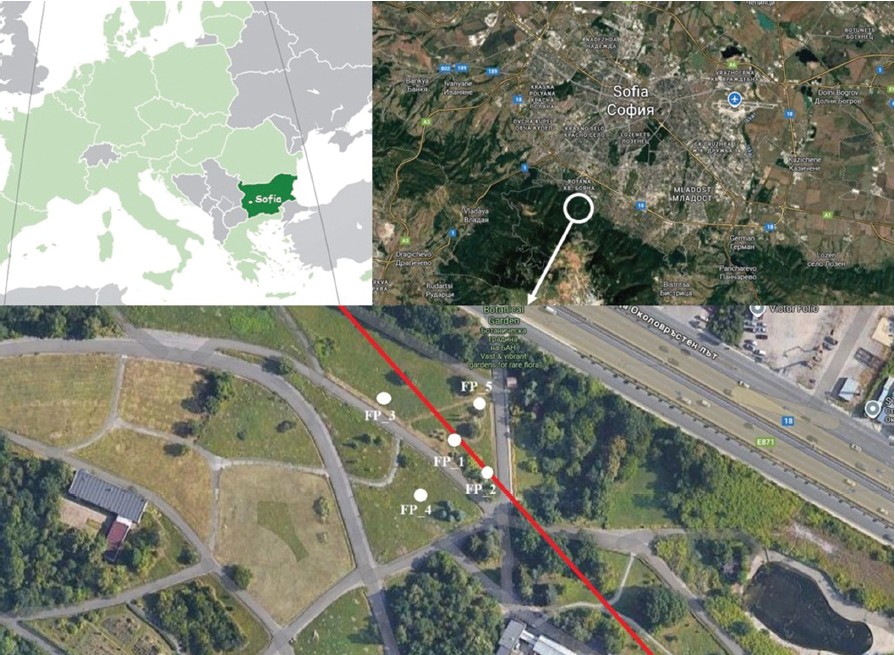
Fig. 1. Location of the studied site and the field points for individual measurements (white circles). The red line traces the Vitosha fault.
Conclusion
The results obtained in this preliminary study provide the first field-based indication of naturally occurring hydrogen within the Sofia Region. The detected hydrogen concentrations, particularly the elevated values recorded along the Vitosha fault zone, suggest an active migration pathway and support the hypothesis that fault-related structures can act as conduits for hydrogen release from deeper geological levels. The spatial correlation between hydrogen anomalies and the fault trace implies a structural control on gas distribution, consistent with patterns observed in other regions worldwide.
Although there are only two measured concentrations above the fault zone, their clear contrast with lateral and atmospheric background levels demonstrates that hydrogen generation and migration processes may be active in this area. These findings highlight the potential significance of fault zones in the localization and accumulation of natural hydrogen in Bulgaria and elsewhere. To confirm and expand upon these observations, future research must involve higher-resolution spatial surveys, and integration with radon and soil permeability data, to better constrain the origin and dynamics of such hydrogen emanations.
Acknowledgements
This work has been carried out in the framework of the National Science Program “Critical and strategic raw materials for a green transition and sustainable development”, approved by the Resolution of the Council of Ministers № 508/18.07.2024 and funded by the Ministry of Education and Science (MES) of Bulgaria. The equipment used at the research is provided by the National Roadmap for Research Infrastructure 2020‒2027 “Energy storage and hydrogen energetics (ESHER)” under grant agreement No. DO1-349/13.12.2023.
References
Alali, A. E., K. F. Al-Shboul, Q. B. Yaseen, A. Alaroud. 2019. Assessment of radon concentrations and exposure doses in dwellings surrounding a high capacity gas turbine power station using passive measurements and dispersion modeling. – J. Environ. Radioact., 196, 9–14; https://doi.org/10.1016/j.jenvrad.2018.10.001
Andreae, T. W., G. A. Cutter, N. Hussain, J. Radford-knoery, M. O. Andreae. 1991. Hydrogen sulfide and radon in and over the western North Atlantic Ocean. – J. Geophys. Res. Atmos., 96, D10, 18753-18760; https://doi.org/10.1029/91JD01628
Antonov, D., B. Kunovska, M. Mutovska, D. Djunakova, S. Kolev, A. Petrova, K. Ivanova, S. Nikolova, A. Benderev. 2022. Dynamics in the radon index measurements at a specific test site. – Rev. Bulg. Geol. Soc., 83, 3, 239–242; https://doi.org/10.52215/rev.bgs.2022.83.3.239
Batenburg, A. M., M. E. Popa, A. T. Vermeulen, W. C. M. van den Bulk, P. A. C. Jongejan, R. E. Fisher, D. Lowry, E. G. Nisbet, T. Röckmann. 2016. Observations of molecular hydrogen mixing ratio and stable isotopic composition at the Cabauw tall tower in the Netherlands. – Atmos. Environ., 147, 12, 98–108; https://doi.org/10.1016/j.atmosenv.2016.09.058
Cao, P., F. Ning. 2025. Origins, migrations and accumulations of natural hydrogen. – Appl. Energy, 401, 126726; https://doi.org/10.1016/j.apenergy.2025.126726
Gelman, S. E., J. S. Hearon, G. S. Ellis. 2025. Prospectivity Mapping for Geologic Hydrogen. Professional Paper 1900. U. S. Geological Survey, 51 p.; https://doi.org/10.3133/pp1900
Jackson, O., S. R. Lawrence, I. P. Hutchinson, A. E. Stocks, A. C. Barnicoat, M. Powney. 2024. Natural hydrogen: sources, systems and exploration plays. – Geoenergy, 2, 1–9; https://doi.org/10.1144/geoenergy2024-002
Jordanov, J. M. 2024. White hydrogen – a new paradigm of applied geology. – Rev. Bulg. Geol. Soc., 85, 3, p. 344.
Kozhoukharova, E., J. M. Jordanov. 2024. Serpentinites as a potential source of geological hydrogen. – Rev. Bulg. Geol. Soc., 85, 3, 144–146; https://doi.org/10.52215/rev.bgs.2024.85.3.144
Langhi, L., J. Strand. 2023. Exploring natural hydrogen hotspots: A review and soil-gas survey design for identifying seepage. – Geoenergy, 1, 1, 1–15; https://doi.org/10.1144/geoenergy2023-014
Lefeuvre, N., L. Truche, F. V. Donzé, F. Gal, J. Tremosa, R. A. Fakoury, S. Calassou, E. C. Gaucher. 2022. Natural hydrogen migration along thrust faults in foothill basins: The North Pyrenean Frontal Thrust case study. – Appl. Geochem., 145, 105396; https://doi.org/10.1016/j.apgeochem.2022.105236
Lodhia, B. H., L. Peeters, E. Frery. 2024. A review of the migration of hydrogen from the planetary to basin scale. – J. Geophys. Res. Solid Earth, 129, e2024JB028715; https://doi.org/10.1029/2024JB028715
Maiga, O., E. Deville, J. Laval, A. Prinzhofer, A. B. Diallo. 2023. Characterization of the spontaneously recharging natural hydrogen reservoirs of Bourakebougou in Mali. – Scientific Reports, 13, 11876; https://doi.org/10.1038/s41598-023-38977-y
Milesi, V., F. Guyot, F. Brunet, L. Richard, N. Recham, M. Benedetti, J. Dairou, A. Prinzhofer. 2015. Formation of CO2, H2 and condensed carbon from siderite dissolution in the 200–300°C range and at 50MPa. – Geochim. Cosmochim. Acta, 154, 201‒211; https://doi.org/10.1016/j.gca.2015.01.015
Neznal, M., M. Neznal, M. Matolín, I. Barnet, J. Miksova. 2004. The New Method for Assessing the Radon Risk of Building Sites. CGS Special Papers 16, Czech Geological Survey, 94 p.
Pashova, L., A. Radulov, R. Ivanov, L. Dimitrova. 2024. Cartographic representation analysis of earthquake hazard and risk maps for the Sofia Region. – In: Bandrova, T., M. Konečný, S. Marinova (Eds.) Proceedings of the 9th International Conference on Cartography and GIS. 16–21 June 2024, Nessebar, Bulgaria, 1022–1033.
Prinzhofer, A., E. Deville. 2015. Natural hydrogen: The forgotten energy carrier. – Int. J. Hydrogen Energy, 40, 17, 5791–5796; https://doi.org/10.1016/j.ijhydene.2015.04.152
Prinzhofer, A, C. S. T. Cissé, A. B. Diallo. 2018. Discovery of a large accumulation of natural hydrogen in Bourakébougou (Mali). – Int. J. Hydrogen Energy, 43, 42, 19315–19326; https://doi.org/10.1016/j.ijhydene.2018.08.193
Prinzhofer, A, I. Moretti, J. Françolin, C. Pacheco, A. d’Agostino, J. Werly, F. Rupin. 2019. Natural hydrogen continuous emission from sedimentary basins: The example of a Brazilian H2-emitting structure. – Int. J. Hydrogen Energy, 44, 12, 5676–5685; https://doi.org/10.1016/j.ijhydene.2019.01.119
Radulov, A., Y. Donkova, M. Yaneva, N. Nikolov. 2023. Multiple ruptures on the North-Sofia fault at Gorni Bogrov from scarp profile and shallow geophysics. – Geologica Balc., 52, 2, 65–74; https://doi.org/10.52321/GeolBalc.52.2.65
Sherwood Lollar, B., O. Warr, A. Neubeck. 2024. Natural hydrogen in the continental crust: Mechanisms and implications. – Nat., 629, 33–42; https://doi.org/10.1016/10.1038/s41586-024-07565-8
Tsenkov, Ts., P. Ivanov. 2004. Investigation of landslide processes in the region of Botanical garden of the Bulgarian Academy of Sciences, Sofia. – In: Proceedings of the International Conference VSU`2004, 2, ІV-1, 39–44 (in Bulgarian with English abstract).
Warwick, N., P. Griffiths, J. Keeble, A. Archibald, J. Pyle, K. Shine. 2022. Atmospheric Implications of Increased Hydrogen Use. Policy paper, UK Government, 75 p.
Wicks, D. 2024. Geologic Hydrogen: Challenges at the interface of geology, geochemistry and engineering. – In: Proceedings of the AGU Fall Meeting 2024, held in Washington, D.C., 9-13 December 2024, Session: Near Surface Geophysics / Unraveling the Mystery of Natural Hydrogen Occurrence and Unlocking Its Potential for Energy Transition I Oral, id. NS41A-01.
Williams, Q., R. J. Hemley. 2001. Hydrogen in the deep Earth. – Annu. Rev. Earth Planet. Sci., 29, 1, 365–418; https://doi.org/10.1146/annurev.earth.29.1.365
Yaneva, M., B. Berov, G. Frangov. 2002. Evolution of Sofia Basin during the Neogene. – Geologica Balc., 32, 2−4, 135−138; https://doi.org/10.52321/GeolBalc.32.2-4.13
Yaneva, M., Y. Donkova. 2017. Quaternary deposits of the alluvial rivers in Sofia Basin, – C. R. Acad. Bulg. Sci., 70, 1, 103–110.
Yver, C., M. Schmidt, P. Bousquet, W. Zahorowski, M. Ramonet. 2009. Estimation of the molecular hydrogen soil uptake and traffic emissions at a suburban site near Paris through hydrogen, carbon monoxide, and radon-222 semicontinuous measurements. – J. Geophys. Res. Atmos., 114, D18304, https://doi.org/10.1029/2009JD012122
Zagorchev, I., R. Marinova, D. Tchounev, P. Tchoumatchenko, I. Sapunov, S. Yanev. 1994. Explanatory Note to the Geological Map of Bulgaria on Scale 1:100 000, Pernik Map Sheet. Geology and Mineral Resources Committee, Geology and Geophysics Ltd, 92 p. (in Bulgarian with English abstract).
Zgonnik, V. 2020. The occurrence and geoscience of natural hydrogen: A comprehensive review. – ESR, 203, 103140; https://doi.org/10.1016/j.earscirev.2020.103140
Първи данни за повишено наличие на естествен водород на площадка в ЮИ София, България
Димитър Антонов1, Цветелина Толева2, Благой Бурдин3, Светослав В. Георгиев1, Юрген Грьоч4